German beer today: local styles, the Oktoberfest six and a shrinking market
German beer in 2026: Kölsch, Altbier, Rauchbier and Gose, the six breweries allowed at the Oktoberfest, who owns German beer, and why Germans drink less of it.
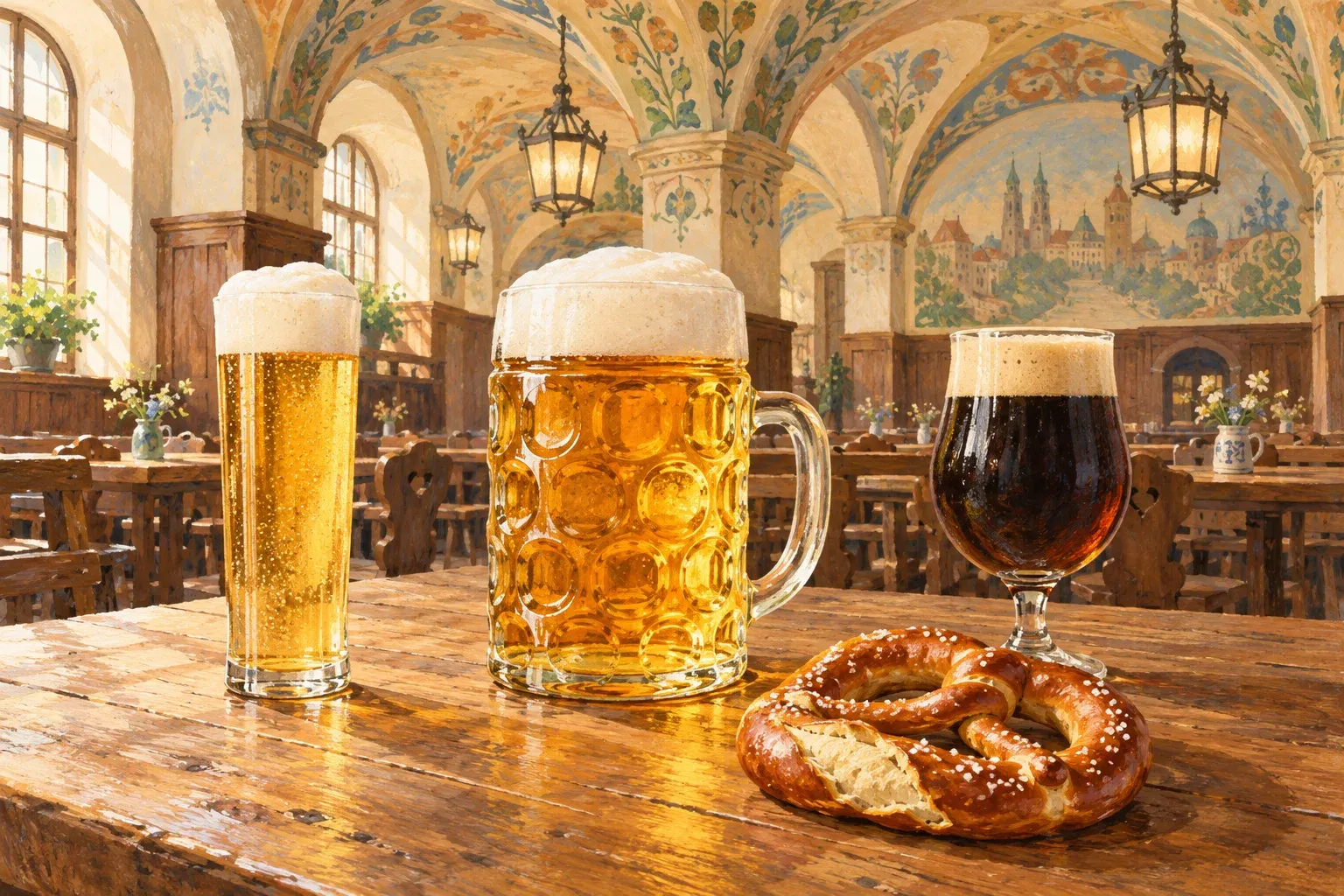
German beer is known for one law, the Reinheitsgebot, but its towns kept their own beers, its biggest festival keeps its own rules, and in 2025 its beer sales fell faster than in any year since 1993.
A town, a beer
Several German cities still hold on to a beer of their own. In Cologne, the Kölsch Konvention, signed by the city’s brewers on 6 March 1986, defines Kölsch as a pale, top-fermented, filtered beer brewed in and around Cologne and served in a slim Stange; Gaffel, Früh and Päffgen still brew it. Down the Rhine, Düsseldorf’s Altbier survives in four old-town house breweries, among them Uerige.
Bamberg has its Rauchbier, poured from oak casks at Schlenkerla. Leipzig revived the salted, sour Gose, a beer documented since 1332, at the Bayerischer Bahnhof. Thuringia’s Schwarzbier went national with Köstritzer after reunification. And the German Pils owes its name to a court: in 1913 the Reichsgericht let Bitburger sell a Pilsener over the objections of the brewers of Pilsen, and Pils became a style rather than a place.
The Oktoberfest six
Only six breweries may pour at the Munich Oktoberfest: Augustiner, Hacker-Pschorr, Löwenbräu, Paulaner, Spaten and the state-owned Hofbräu. Their beer must follow the Munich purity law of 1487, and since October 2022 Oktoberfestbier has been a protected geographical indication in the EU. What they pour has changed: Paulaner created a golden version in the mid-1970s, and since 1990 most beer at the festival has been this paler Festbier, not the amber Märzen of old.
Four of the six belong to two groups. Hacker-Pschorr and Paulaner are part of the Paulaner group, 70% owned by the Schörghuber family company and 30% by Heineken; Spaten and Löwenbräu belong to AB InBev. Only Augustiner, kept independent by a foundation, and Hofbräu, owned by the Bavarian state, stand alone.
Who owns German beer
Germany’s largest brewing group, the Radeberger Gruppe, belongs to the Oetker family’s group and owns about 60 brands, from Radeberger and Jever to Berliner Kindl. AB InBev holds Beck’s as well as Spaten and Löwenbräu. Large family brewers, Krombacher, Warsteiner, Veltins and Erdinger, stay independent, and the Bitburger group, owned by the Simon family and its relatives, also owns Köstritzer.
Less beer, fewer breweries
According to Destatis, German breweries sold about 7.8 billion litres of beer in 2025, 6.0% less than a year before and the steepest fall since its series began in 1993. The number of breweries fell to 1,415, 137 fewer than in 2019; Bavaria still has 588. The changes show up across the trade. In May 2026 Warsteiner said it would stop brewing at Herford and sell or close Paderborn. In January 2026 Schneider Weisse agreed to take over the Bischofshof and Weltenburger brands from 2027, while Bischofshof closes its Regensburg brewery, and in 2025 Gaffel took over Mühlen Kölsch.
Sources
Checked .
- Kölsch-Konvention — Wikipedia (German)
- Gose — Wikipedia (German)
- Bitburger Brauerei — Wikipedia (German)
- The six Munich breweries at Oktoberfest — Oktoberfest.de, City of Munich
- Oktoberfestbier wird geschützte geografische Angabe — Verein Münchener Brauereien
- 4B. Festbier, 2021 Beer Style Guidelines — Beer Judge Certification Program
- Radeberger Gruppe — Wikipedia (German)
- Unsere Marken — AB InBev Deutschland
- Unternehmen — Paulaner Brauerei Gruppe
- 6,0 % weniger Bier im Jahr 2025 abgesetzt — Destatis
- Zahl der Brauereien auf 1 415 im Jahr 2025 gesunken — Destatis
- Traditionsbiermarken Schneider Weisse, Bischofshof und Weltenburger ab 2027 unter einem Dach — Kloster Weltenburg