From the Baltic to the Danube: Vienna lager, Baltic porter and farmhouse ales
Beer in Austria, Poland, the Baltic states and Slovakia: Dreher's Vienna lager, the Baltic porters, Grodziskie's revival, Lithuania's farmhouse ales and who owns the big brands.
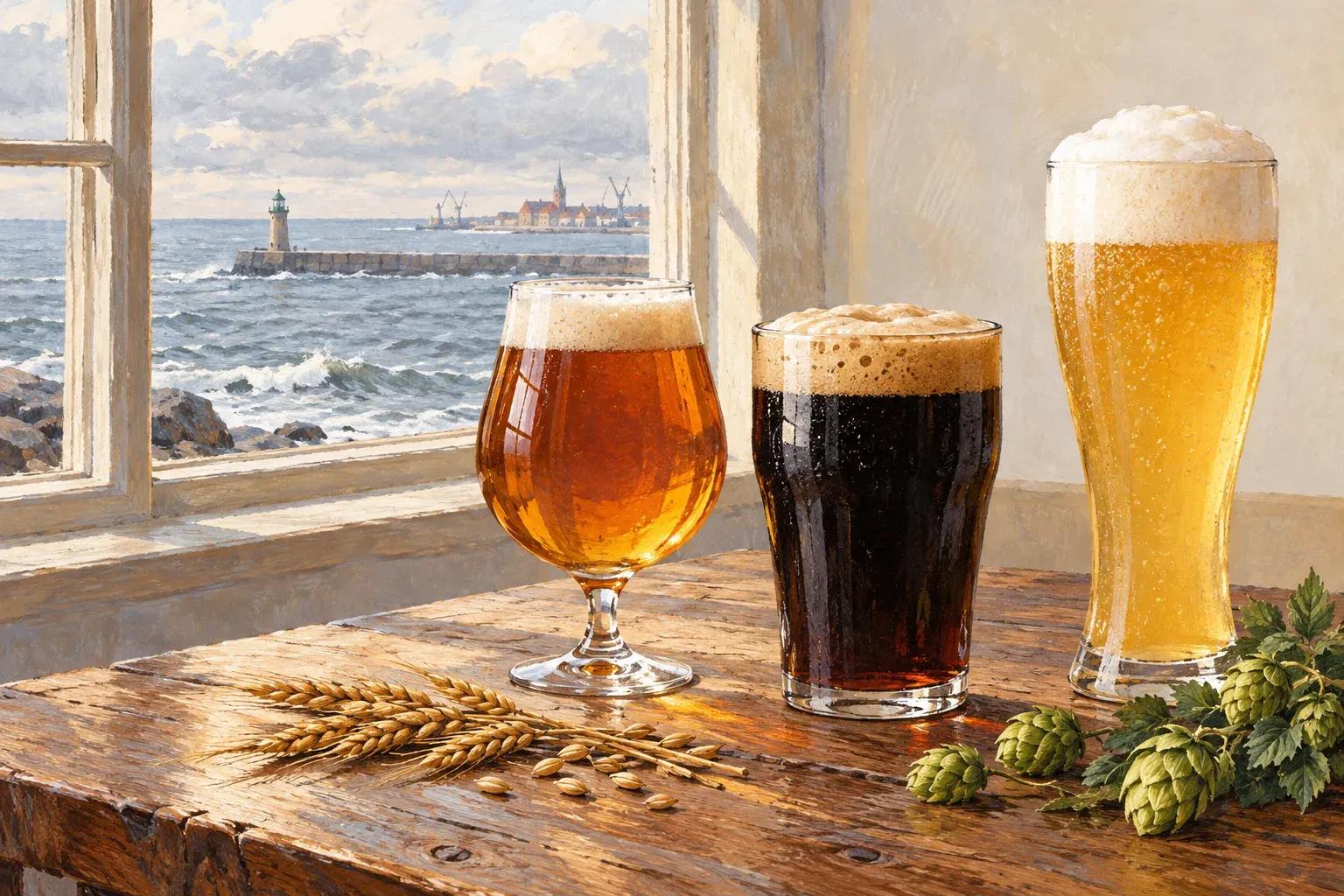
Between the Baltic Sea and the Danube, brewers gave the world a lager, kept their own porters, and revived beers that had died out. Most of the big brands now belong to four groups, while small brewers have brought the old styles back.
Vienna lager
In 1841, at his family’s brewery at Schwechat near Vienna, Anton Dreher brewed a new amber lager. He had studied at Spaten in Munich and at Barclay Perkins in London, made his pale malt the English way and fermented with lager yeast from Munich, lagering the beer in cold cellars. The result was the Vienna lager, which Austrian brewers later took as far as Mexico. In Vienna, Ottakringer’s Wiener Original is a classic example. Austrians drink a different Märzen from the Bavarians: in Austria the name means the pale everyday lager, such as Stiegl-Goldbräu or Gösser Märzen.
Porter by the Baltic
When English porter stopped reaching the Baltic in the early 1800s, brewers around the sea made their own, the beers now called Baltic porter. In Poland, Żywiec has brewed its porter since 1881, from a recipe by its head brewer Juliusz Wagner, and both it and Okocim’s Mistrzowski Porter are BJCP classics. In Riga, the BJCP lists Aldaris’s porter too. In Russia, VG Invest took full ownership of Baltika, whose No. 6 is another classic, in June 2026.
Beers that came back
Grodzisk Wielkopolski gave its name to a light, bitter wheat beer made from oak-smoked malt, known in German as Grätzer. Its brewery closed in 1993, and the style died with it. Polish craft brewers brought it back: Pinta’s founders brewed A’la Grodziskie in 2010, and Browar Grodzisk has brewed Grodziskie again since 2015. Pinta’s Atak Chmielu, an American IPA first brewed on 28 March 2011, is often taken as the start of Poland’s craft beer revival.
Lithuania never fully lost its farmhouse brewing. Its kaimiškas ales include raw ales, made without boiling the wort and bittered with hop tea, and keptinis, whose mash is baked in loaves before it is mashed again. At Jovarai, Aldona Udrienė’s family brews a raw ale that the EU has protected since 2019.
Who owns the big brands
Four groups own most of the region’s big brewers. Asahi has Tyskie and Lech in Poland and Šariš in Slovakia. Heineken has Żywiec, the Austrian Brau Union with Gösser, Zipfer and Schwechater, and Zlatý Bažant. Carlsberg has Okocim, Aldaris, Švyturys and Saku. Finland’s Olvi owns A. Le Coq in Estonia, Volfas Engelman in Lithuania and Cēsu Alus in Latvia. Family brewers such as Stiegl and Trumer in Austria stay independent.
Sources
Checked .
- 7A. Vienna Lager, 2021 Beer Style Guidelines — Beer Judge Certification Program
- Our breweries — Brau Union Österreich
- 9C. Baltic Porter, 2021 Beer Style Guidelines — Beer Judge Certification Program
- 27A. Historical Beer: Piwo Grodziskie, 2021 Beer Style Guidelines — Beer Judge Certification Program
- Legenda — Browar Grodzisk
- Atak Chmielu — Browar Pinta
- Kaimiškas: Get Raw & Rustic with Lithuania's Unique Farmhouse Beers — Craft Beer & Brewing
- Olvi Group — Olvi
- VG Invest became the sole owner of Baltika — Vedomosti