Nordic beer: Carlsberg's yeast, farmhouse brewing and the state shops
Nordic beer from Carlsberg's pure lager yeast of 1883 to Finnish sahti, Norwegian kveik, Baltic porter, Iceland's beer ban and the state alcohol shops.
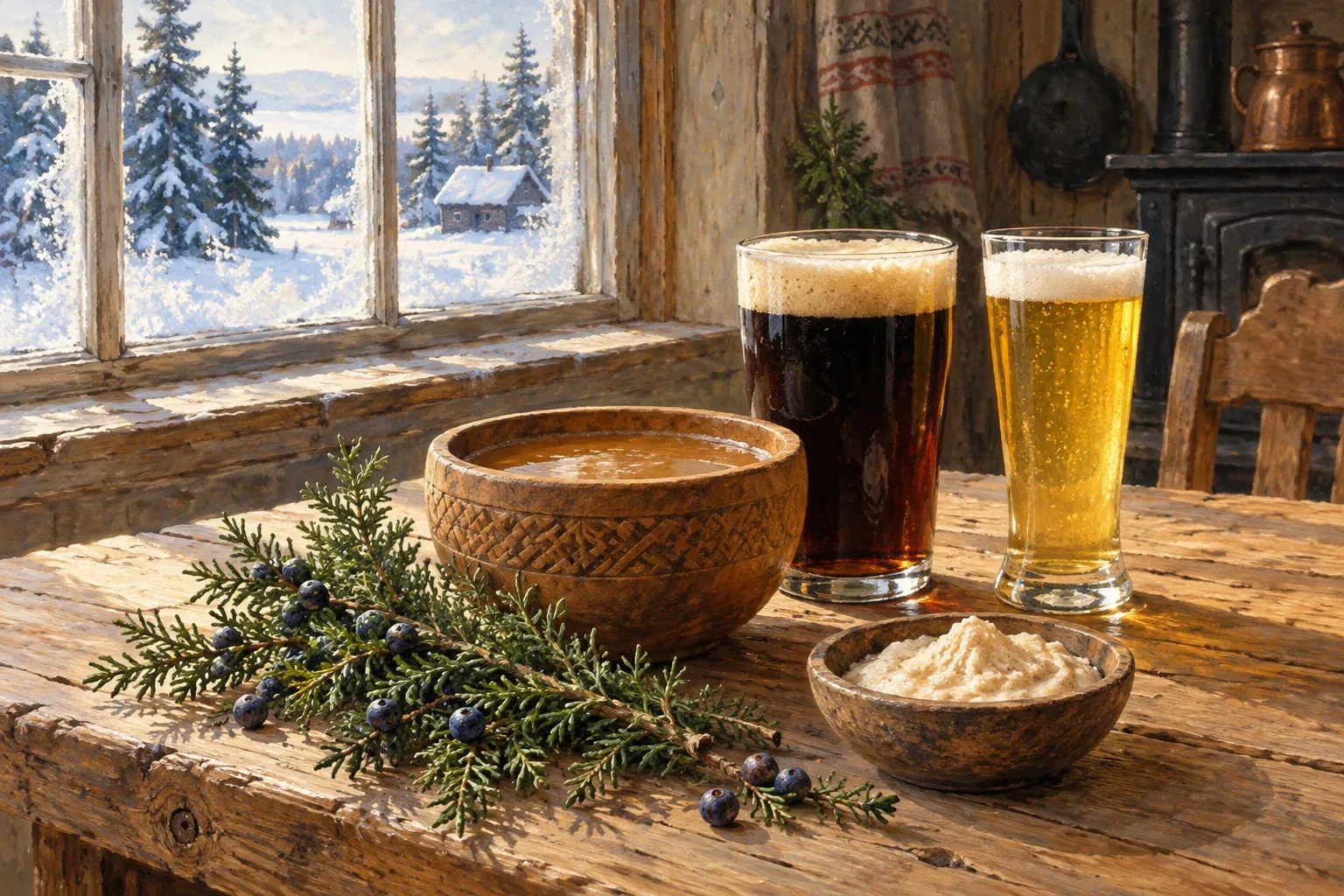
A Danish laboratory grew the first pure culture of lager yeast, Finnish and Norwegian farms kept centuries-old farmhouse brewing alive, and the state alcohol shops of the north still decide how strong a beer may be on a supermarket shelf.
The yeast that changed lager
Brewers of the time often lost batches to “beer sickness”. At the Carlsberg Laboratory in Copenhagen, founded in 1875, Emil Christian Hansen showed in 1883 that wild yeast mixed into the brewing yeast caused it. He isolated a single good yeast cell and grew it into a pure culture, and Carlsberg brewed with it on a production scale in November 1883. The yeast took the laboratory’s name, Saccharomyces carlsbergensis. In Oslo, Ringnes says it was the first Norwegian brewery to breed its own pure yeast.
Farmhouse brewing
On Finnish farms, brewers have made sahti for at least 500 years: a strong, sweet, cloudy ale of barley and rye, filtered through juniper boughs, never boiled and fermented with baker’s yeast. Selling it became legal in 1987, when Lammin Sahti and Joutsan Sahti began, and in 2002 the EU protected the name. On the Swedish island of Gotland, gotlandsdricka, smoky and flavoured with juniper, was traditionally brewed only by women.
In western Norway, farm brewers kept their own yeasts, called kveik, and a handful of traditional brewers still keep the old strains alive. A genome study published in 2018 found that kveik forms a genetically distinct group of domesticated brewing yeasts, fast to ferment and reportedly tolerant of high temperatures.
Porter on the Baltic
When English porter stopped reaching the Baltic in the early 1800s, brewers around the sea made their own, the beers now called Baltic porter. In Helsinki, Sinebrychoff, founded in 1819, has brewed its KOFF Porter since 1957, and the BJCP counts it among the style’s examples. In Sweden, Carnegie Porter, now brewed by Carlsberg Sverige, traces itself to Gothenburg in 1817.
Brewing for the state shops
In Sweden, Systembolaget is the only shop that may sell drinks over 3.5% alcohol, to buyers aged 20 or over. In Norway, Vinmonopolet holds the same right above 4.75%, and in Finland, Alko above 8%. Brewers answer with two strengths of the same beer, a weaker one for the supermarket and a stronger one for the state shop. Iceland went furthest: it banned alcohol from 1915 and kept strong beer illegal until 1 March 1989, so Ölgerðin brewed weak beer for 74 years. Icelanders now celebrate 1 March as Beer Day.
The craft wave
Craft brewing took hold in the 2000s. Nøgne Ø started in a garage in Grimstad in 2002. In Copenhagen, Mikkeller became the best-known gypsy brewer, renting other breweries’ kit, and in Stockholm a brewer and an artist built Omnipollo. In Stavanger, Lervig turned from pilsner to imperial stouts and hazy IPAs, and has complained that the Vinmonopolet lists new beers too slowly for fresh IPA. The big groups have since moved in: Carlsberg bought 20% of Mikkeller in January 2024.
Sources
Checked .
- Purifying yeast — Carlsberg Group
- Carlsberg Laboratory — Wikipedia
- Historie — Ringnes
- 27A. Historical Beer: Sahti, 2021 Beer Style Guidelines — Beer Judge Certification Program
- Sahti — Wikipedia (Finnish)
- Kveik — Wikipedia
- Traditional Norwegian Kveik Are a Genetically Distinct Group of Domesticated Saccharomyces cerevisiae Brewing Yeasts — Frontiers in Microbiology (Preiss et al., 2018)
- Gotlandsdricka — Wikipedia
- 9C. Baltic Porter, 2021 Beer Style Guidelines — Beer Judge Certification Program
- KOFF Porter — Sinebrychoff
- Systembolaget — Wikipedia
- Vinmonopolet — Wikipedia
- Alko — Wikipedia
- Beer in Norway — Wikipedia
- Beer Day (Iceland) — Wikipedia
- Carlsberg buys 20% stake in international craft brewery Mikkeller — Inside Beer