

Beer from the Andes to the Caribbean: national lagers, big owners and tropical stout
Beer from Peru, Colombia and Bolivia to Guatemala, Jamaica and Trinidad: Cristal, Águila, Paceña, Gallo, Red Stripe and Carib, who owns the national brewers, Heineken's 2026 deal in Central America, and the Caribbean's tropical stout.
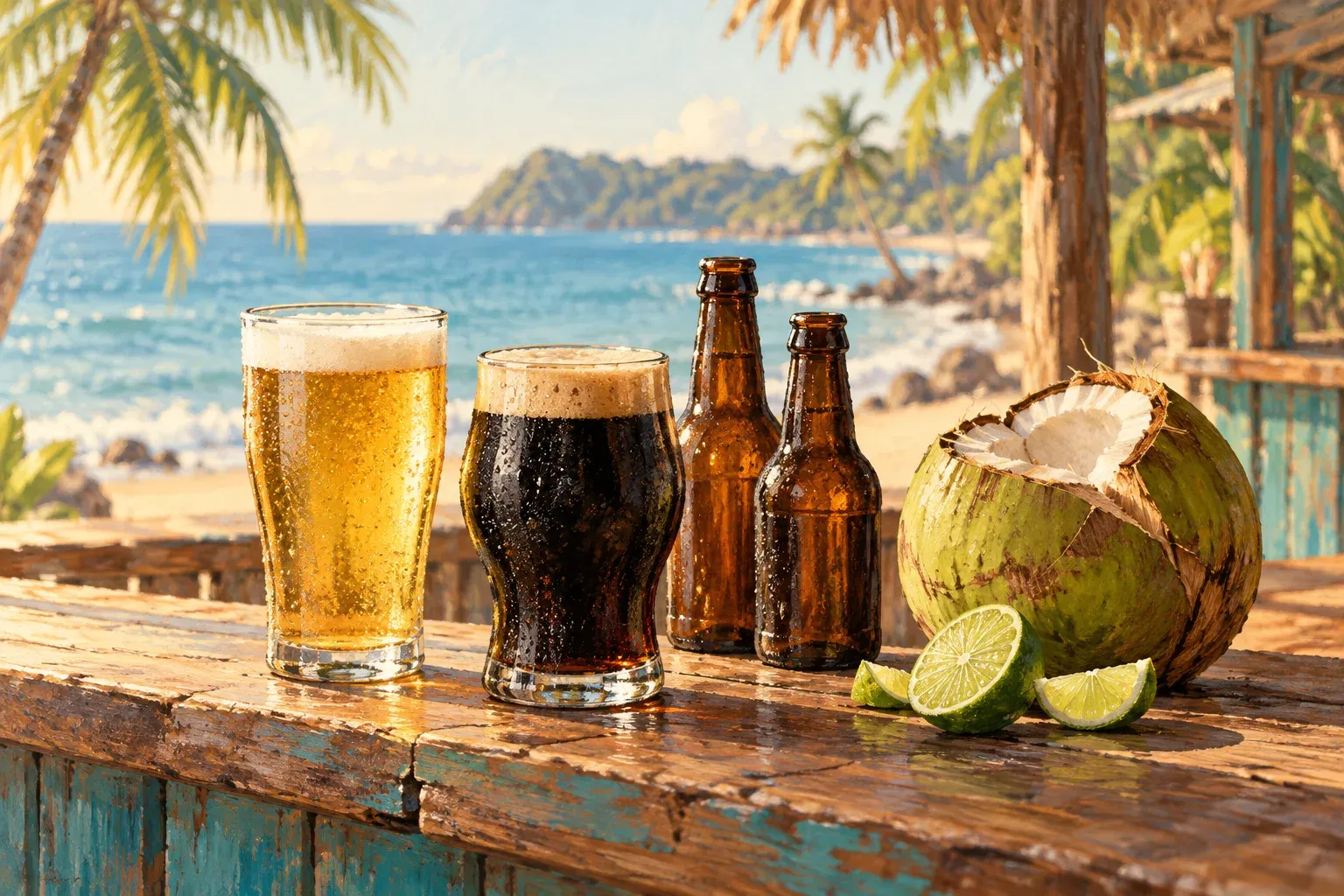
Foreigners founded most of the national breweries between the Andes and the Caribbean. Americans started Backus in Lima in 1879, the German Kopp brothers Bavaria in Bogotá in 1889, and a German brewmaster is credited with the recipe for Bolivia’s Paceña. Almost every country ended up with one dominant brewer making a light golden lager under the national name: Cristal and Cusqueña in Peru, Águila and Club Colombia in Colombia, Pilsener in Ecuador, Paceña in Bolivia, Gallo in Guatemala, Imperial in Costa Rica, Red Stripe in Jamaica, Presidente in the Dominican Republic, Carib in Trinidad, Kalik in the Bahamas and Prestige in Haiti.
The Andes
Bavaria gathered the region’s breweries: it bought into Ecuador’s Cervecería Nacional in the 1980s, Panama’s in 2001 and Backus in 2002–05. The group passed to SABMiller in 2005 and to AB InBev in 2016, which also owns Bolivia’s CBN. The result is near-monopoly: Backus brews more than 80% of Peru’s beer, Bavaria more than 90% of Colombia’s and CBN about 90% of Bolivia’s. In Colombia, Central Cervecera, owned by the soft-drink maker Postobón and Chile’s CCU, has challenged Bavaria since 2019 and holds about 7%. Altitude shapes Bolivian brewing: in La Paz, at almost 3,600 metres, water boils at about 89 °C, so CBN boils its wort under pressure.
Venezuela is the exception. Polar, founded in 1941 by Lorenzo Mendoza Fleury, still belongs to his family, though shortages of imported malt have closed several of its breweries since 2016.
Craft brewing is small and often bought. AB InBev took Bogotá Beer Company in 2015 and the brand of Lima’s Barbarian in 2019. Cervecería del Valle Sagrado, near Cusco, stays independent and has won more than 120 medals with beers made from Andean produce.
Central America
In September 2025 Heineken agreed to buy the beverage business of Costa Rica’s FIFCO, brewer of Imperial, with its stakes in Panama and Nicaragua’s Toña and Victoria, for about US$3.2 billion; the deal closed on 30 January 2026. AB InBev owns the national brewers of Panama, El Salvador and Honduras. Guatemala’s Cervecería Centro Americana, maker of Gallo since 1896, is still run by the founding Castillo family. In El Salvador, AB InBev had to sell Regia and Suprema after buying SABMiller, and since January 2026 Cervecería Salvadoreña has brewed them at its own new brewery, the first large brewery founded with local money in the country in more than a century.
The Caribbean
Several island brewers began under a government licence or monopoly. In 2026 their ownership splits three ways: Heineken owns Desnoes & Geddes in Jamaica, Commonwealth Brewery in the Bahamas and BRANA in Haiti; AB InBev’s Ambev owns most of Cervecería Nacional Dominicana and half of Cuba’s Bucanero; and local owners keep Carib, Puerto Rico’s Valdés family brewery, Belize Brewing and the Bahamian Brewery. Brewers look for local starch and sugar: Red Stripe and Dragon Stout use cassava grown in Jamaica, and Prestige replaced maize with cane sugar.
The islands also drink stout. British and Irish porter came to the Caribbean from the 17th century, and Guinness shipped West India Porter there from at least 1801; it became Guinness Foreign Extra Stout, which several island brewers now make or bottle under licence. Local brewers made their own, sweeter and less bitter because it did not have to travel: the BJCP calls the style tropical stout. Carib’s Royal Extra Stout dates from about 1908 and is called the Caribbean’s oldest beer brand; Jamaica’s Dragon Stout dates from the 1920s and was relaunched in 1961; and Strong Back Stout comes from the independent Bahamian Brewery. All three are among the BJCP’s examples of the style.
Sources
Checked .
- Heineken to acquire FIFCO's beverage and retail businesses — Heineken
- FIFCO concreta la venta de sus negocios a Heineken — CRHoy
- Cervecería Salvadoreña inicia la producción de Suprema y Regia — Diario El Salvador
- Cervecería Bavaria — Wikipedia
- Del 7 al 12 % del mercado: el salto que busca Central Cervecera en 5 años — El Tiempo
- Cerveza Paceña — Wikipedia
- Cervecería Polar — Wikipedia
- The Popular Origins of Caribbean Stout — Craft Beer & Brewing
- 16C. Tropical Stout, 2021 Beer Style Guidelines — Beer Judge Certification Program
- Guinness Foreign Extra Stout — Wikipedia
- About Carib Brewery — Carib Brewery
- Red Stripe's Project Grow to add 120 acres — Jamaica Observer