

American beer: German lager, Prohibition, the craft boom and a harder decade
American beer from Budweiser and Yuengling to Sierra Nevada, Heady Topper and Pliny the Elder: German immigrant lager, Prohibition, the home brewers who started craft beer, and the closures and sales of 2023–2026.
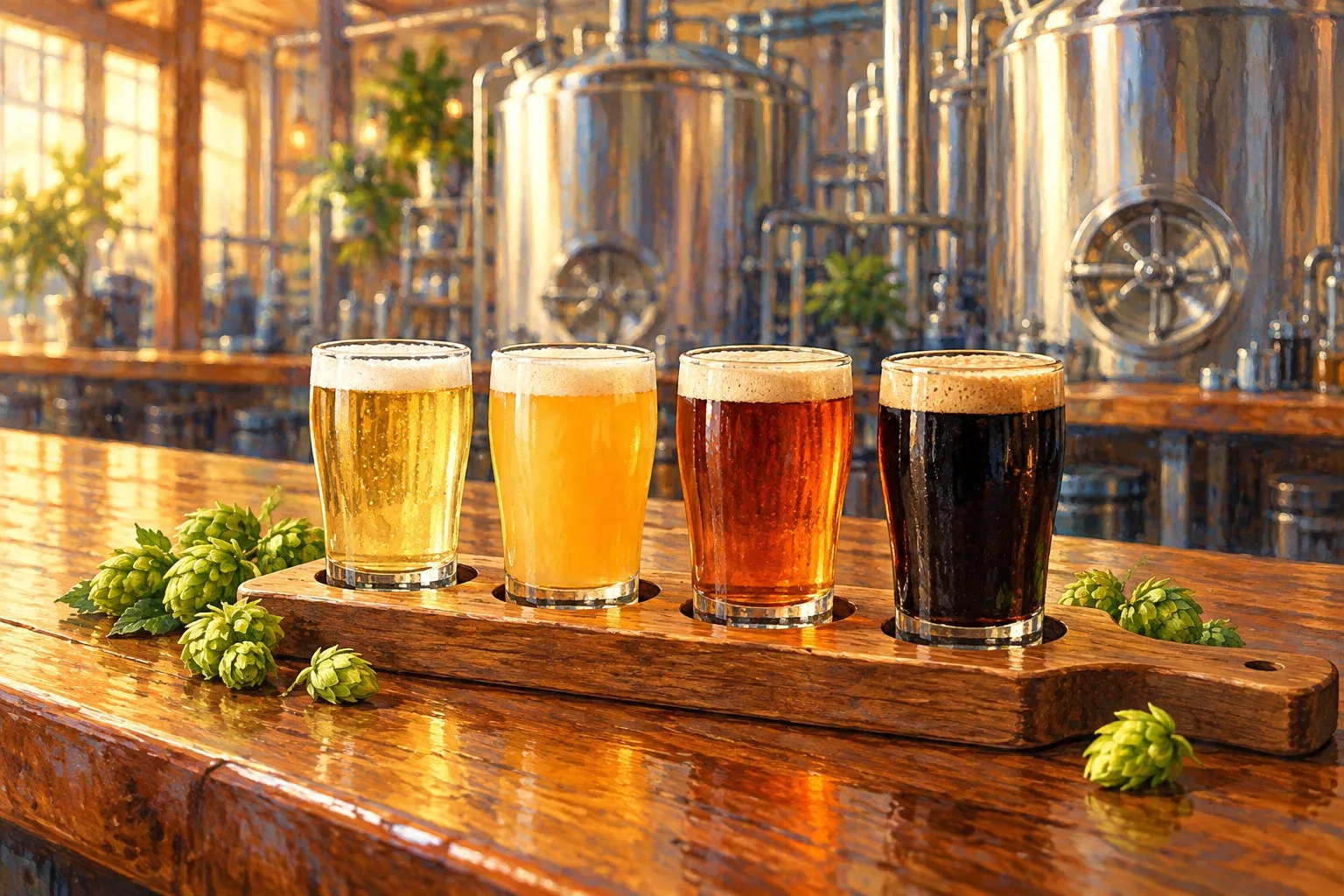
Until the middle of the 19th century Americans drank mostly British-style ale. German immigrants changed that. Lager kept longer and travelled better, and it suited brewing on a large scale. Milwaukee’s big names were German: Jacob Best, whose brewery became Pabst, August Krug, whose became Schlitz, and the founders of Blatz and Miller. In St. Louis, Adolphus Busch pasteurised his beer and shipped it in refrigerated rail cars, and Anheuser-Busch’s Budweiser of 1876 became the first national brand. The older family breweries that survive came from the same wave: Yuengling of Pottsville, founded in 1829 and the oldest in the country, and Straub, founded in 1872 by a brewer from Württemberg. The BJCP’s pre-Prohibition lager, bitter and rich with corn, is the beer they adapted from home.
Prohibition and after
National Prohibition ran from 1920 to 1933. Breweries made near beer, malt extract and other goods to survive: Anheuser-Busch made ice cream, and Pabst sold cheese. Beer came back in April 1933, a few months before repeal, and few breweries came with it. The survivors merged, sold across the country and advertised one beer to everyone, the pale, light American lager. By 1978 the country had 42 breweries. Repeal also left most states with the three-tier system: brewers sell to distributors, distributors to shops and bars, and only those sell to drinkers.
Home brewers start again
Fritz Maytag saved Anchor of San Francisco in 1965, kept its steam beer, now the California common, and in 1975 brewed Liberty Ale with whole Cascade hops. In 1976 Jack McAuliffe opened New Albion in Sonoma, the first microbrewery of modern America. It closed in 1982, but it inspired others. On 14 October 1978 the United States legalised home brewing, and the home brewers who turned professional built the craft industry: Ken Grossman and Paul Camusi at Sierra Nevada in 1980, Larry Bell at Bell’s, and later the founders of Founders and Tree House. American hops such as Cascade, Citra and Simcoe gave their beer its taste, from the pale ale and IPA to Pliny the Elder, the double IPA, and The Alchemist’s Heady Topper, which the BJCP names as the probable start of the hazy IPA.
Those hops grow in the Pacific Northwest. In 2025 Washington harvested 31,198 of the country’s 41,654 acres of hops, most of them in the Yakima Valley; Oregon and Idaho grew the rest. Breweries such as Deschutes, pFriem and Fremont work close to the fields.
A harder decade
The Brewers Association counted 9,578 craft breweries in 2025, 2.9% fewer than a year before. 300 opened and 481 closed, and craft output fell 4%. All beer fell faster, by 5.7%, so craft’s share of volume rose slightly, to 13.4%. The large brewers had their own troubles: a boycott from April 2023 cost Bud Light its place as the best-selling US beer, which another Anheuser-Busch beer, Michelob Ultra, took in 2025. In January 2025 Molson Coors closed the Leinenkugel’s brewery in Chippewa Falls after 157 years.
The years 2023 to 2026 also brought a run of sales and closures:
- Sapporo shut Anchor in July 2023; Chobani’s founder bought it in 2024, but it was still not brewing in late September 2026.
- Firestone Walker and Duvel Moortgat USA bought Stone from Sapporo in April 2026, and Sapporo began winding down the Escondido brewery.
- Pabst ended Schlitz in May 2026.
- A private equity firm bought Genesee in September 2026.
- The founders of Jester King put their Texas farmhouse brewery up for sale in October 2026, after interest in wild ales had fallen since 2022.
The big independents hold their ground. Yuengling is the largest craft brewer, ahead of Sierra Nevada and Boston Beer, and Brooklyn planned a move to a site four times larger in 2026.
Sources
Checked .
- Beer in the United States — Wikipedia
- Prohibition in the United States — Wikipedia
- Three-tier system (alcohol distribution) — Wikipedia
- A Year of Correction for Craft Beer, With Early Signals of Recovery — Brewers Association
- Hops 2025 National Summary — USDA National Agricultural Statistics Service
- 21C. Hazy IPA, 2021 Beer Style Guidelines — Beer Judge Certification Program
- Stone Brewing Sold to Firestone Walker and Duvel USA — Brewbound
- Top Texas craft brewery owners aim to sell business — Houston Chronicle
- Genesee Brewing Co. has a new owner — WXXI News
- Pabst ending production of Schlitz beer after more than 175 years — KOLD News 13
- Molson Coors to close Leinenkugel's Brewery in Chippewa Falls — WPR
- Michelob Ultra becomes best-selling beer in the US — BBC