Italian beer: Peroni, Moretti and the craft year of 1996
Italian beer from Peroni and Moretti to Baladin and Birrificio Italiano: who owns the big brands, the 1996 craft pioneers, the 2016 craft beer law, and beers brewed with grapes and chestnuts.
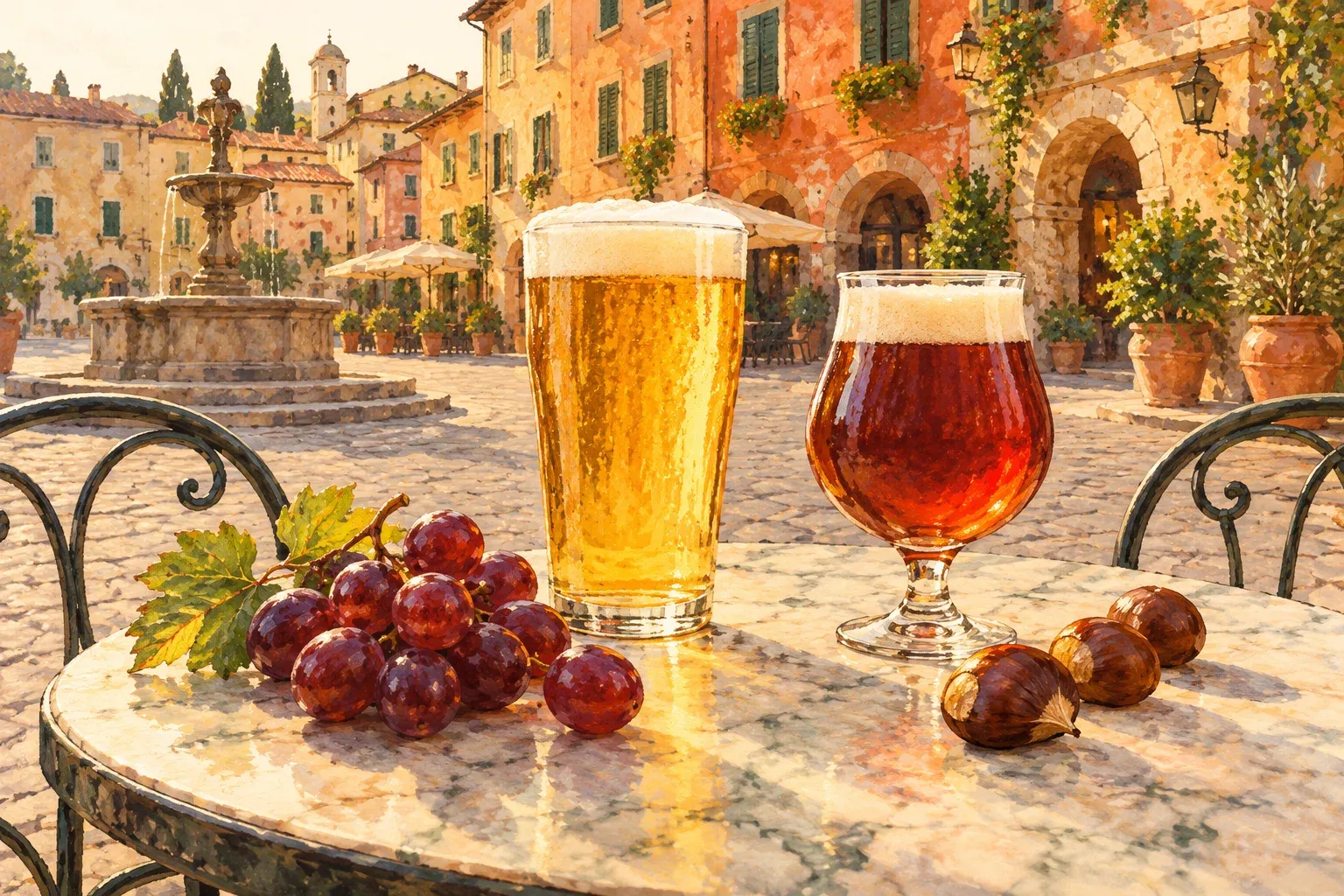
Italy drinks about 21 million hectolitres of beer a year and brews over 16 million. Two global groups brew about half of it, while a craft scene that began in 1996 has given the world two styles of its own.
Who brews Italy’s beer
Heineken Italia calls itself the country’s largest brewer, with about a third of the market. It owns Birra Moretti and Sardinia’s Ichnusa, and its brewery at Comun Nuovo, near Bergamo, is the largest in Italy. Peroni, founded in 1846, has belonged to Asahi since 2016 and held 17.8% of the market in 2025. Carlsberg owns Poretti. The largest Italian-owned brewers are regional: Forst in South Tyrol, which also owns Menabrea of Biella, and Birra Castello, which brews at Pedavena in the Dolomites, the brewery a public campaign saved from closure in 2006. Beer brewed elsewhere in Europe, above all in Germany, makes up about 35% of what Italians drink, AssoBirra reports.
1996
Three breweries began that year: Baladin in Piozzo, Birrificio Italiano near Como and Lambrate in Milan. Baladin’s Isaac and Super of 1997 were the first Italian craft beers sold in bottles, and Birrificio Italiano’s Tipopils, a pale lager dry-hopped in 1996, became the model for the Italian pilsner. The pioneers founded Unionbirrai, Italy’s first association of small breweries, in 1999.
In 2016 Italy wrote craft beer into law. A birra artigianale must come from a brewery that is legally and economically independent, uses its own plant, brews under no one else’s licence and makes at most 200,000 hectolitres a year, and the beer must not be pasteurised or microfiltered. Unionbirrai counted 942 such breweries in 2025, brewing about 4.2% of Italian beer.
Grapes and chestnuts
The most Italian beers borrow from the farm. Montegioco in Piedmont and Barley in Sardinia first brewed with wine grapes and must in 2006 and 2007, and the BJCP now lists the Italian Grape Ale as an Italian style. Grado Plato, near Turin, flavours its Strada San Felice lager with chestnuts and malts barley from its own farm. Baladin grows its own barley and hops, and its founder co-designed the Teku tasting glass in 2004.
Sold and closed
Big brewers bought into craft, and some left again. Duvel Moortgat took control of Del Ducato in 2018, and its beers lost the right to be called artigianali. AB InBev, which bought Birra del Borgo in 2016, announced its closure in June 2026. Baladin went the other way: in October 2026 it agreed a EUR 16.4 million investment from a Dutch family office, and it sells in 47 countries.
Sources
Checked .
- Il gruppo in Italia — Heineken Italia
- Birra Peroni, siglato l'accordo integrativo aziendale — Distribuzione Moderna
- Annual Report 2025 — AssoBirra
- Chi siamo — Unionbirrai
- Legge 28 luglio 2016, n. 154, articolo 35 — Gazzetta Ufficiale
- La birra artigianale oltre il 4% — Cronache di Birra
- AB InBev chiude Birra del Borgo — Beverfood
- X3. Italian Grape Ale, 2021 Beer Style Guidelines — Beer Judge Certification Program
- Birrificio Italiano, 30 anni — MilanoToday