From mead to Obolon: a history of brewing in Ukraine
Brewing in Ukraine from the mead and kvass of Kyivan Rus' to Lviv's 1715 brewery, Czech hop growers in Volhynia, Soviet Zhyhulivske, Obolon and the craft brewers of today.
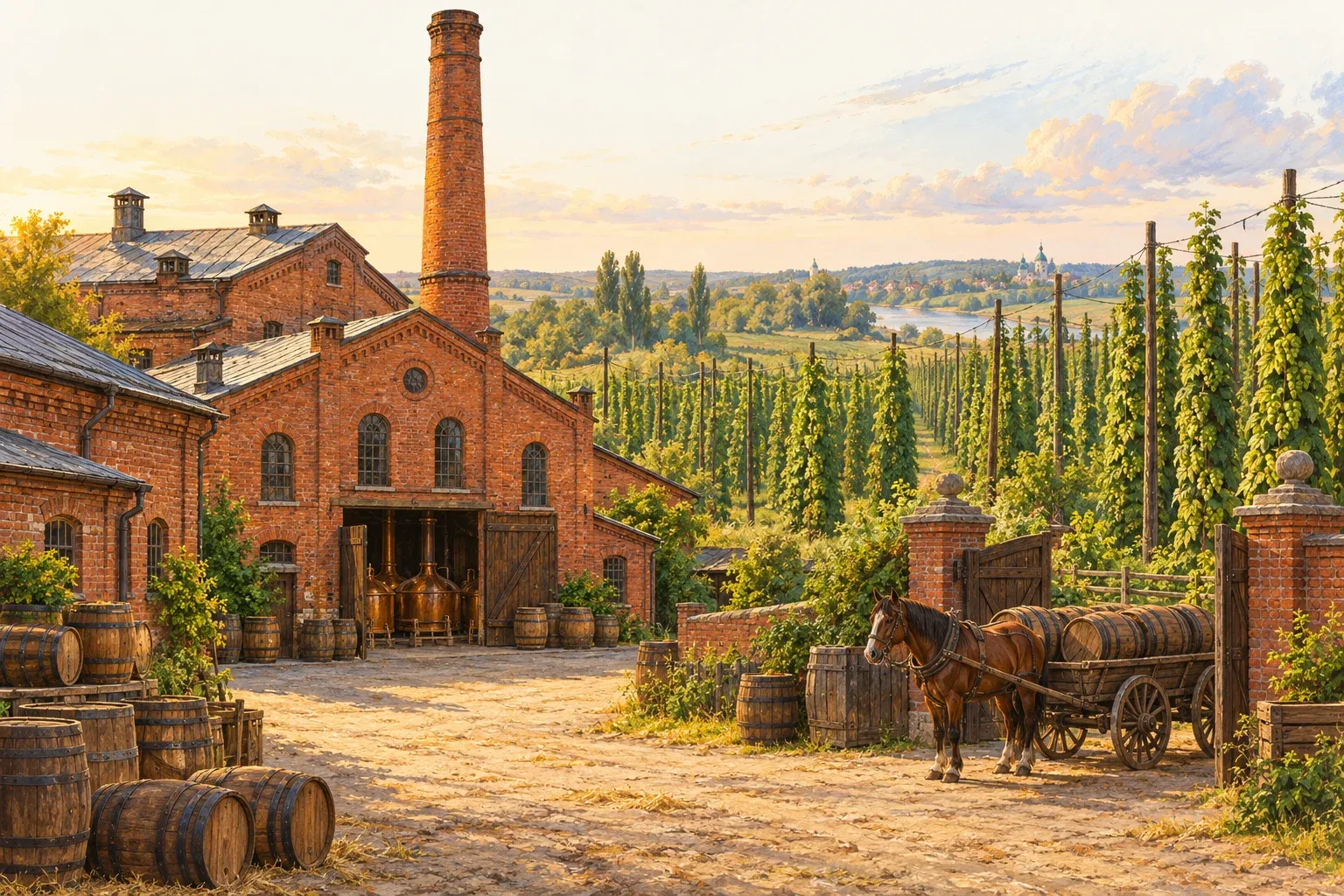
Ukraine’s oldest records speak of mead and kvass more than of beer. Brewing grew in the towns of the Polish crown, turned industrial under the Habsburgs and the tsars with help from German and Czech brewers, and was standardised by the Soviet state before independent Ukraine’s brewers sold out or held on.
Mead and kvass in Kyivan Rus’
The Primary Chronicle records that Prince Volodymyr made peace with the Volga Bulgars in 985 to last until stone floats and hops sink. Under 996 it tells how he sent carts round Kyiv with bread, meat, fish, mead in barrels and kvass for the sick and poor; it names no beer. In Nestor’s Life of Theodosius, written in the Kyiv Caves monastery in the 11th century, the word pivo stands for a drink that turns out to be mead. No source we checked dates a first written mention of barley beer in Rus’.
The monks brewed later. The Kyiv-Pechersk Lavra Preserve says its Lybidska brewery made kvass, beer and a sour malt drink the archives call “semi-beer”, which the Lavra served at its public dinners from Metropolitan Filaret’s time (1837-1854) and sent to Hetman Pavlo Skoropadskyi’s table in 1918.
Guilds and the nobles’ monopoly
Lviv had Magdeburg law, the German town law that gave towns self-government, before 1352, and Kyiv from 1494. Lviv’s tourist office counts the 1425 charter of the city’s brewers’ guild as the first record of brewing there. In the countryside the nobles held propination, the sole right to make and sell spirits, beer and mead on their estates, as Ivan Franko defined it. The 1648 rising under Bohdan Khmelnytskyi swept it away on the Cossack Left Bank; in Galicia it lasted until the nobles sold the right to the province, for 66 million by Franko’s account.
Lviv and Mykulyntsi
Lviv Brewery takes 1715 as its official date, when Jesuits built a brewery in the Klepariv suburb. Robert Doms bought it in 1863 and installed steam engines; by the Encyclopedia of Modern Ukraine’s account it ranked by the mid-19th century among the three best breweries in Austria-Hungary, and it brewed 300,000 hectolitres of beer and mineral water in 1937. Mykulynetskyi Brovar, near Ternopil, claims 1497.
Czech hops, German brewers
In the Russian Empire, Czech farmers settled in Volhynia from the 1860s. A 2026 study from Vinnytsia’s pedagogical university finds that Czechs from the hop districts around Žatec planted the first Saaz hops in Dubno county in 1870; by 1900 the province had 1,302 desyatins of hop gardens, and by the 1910s it was the empire’s main hop region. A Kyiv University paper counts 22 Czech-owned breweries in Volhynia before the First World War. Czech settlers founded the Zhytomyr brewery in 1878, and Ukrainian Wikipedia credits two Czech brothers with the Radomyshl brewery in 1906. In Odesa, Wilhelm Sanzenbacher, of German colonist stock, opened the city’s largest brewery in 1890 and sold his beer as far as Romania, Bulgaria and North Africa.
The Soviet standard
The Soviets nationalised the breweries, Odesa’s in 1920 and Lviv’s and Ternopil’s after the Soviet takeover of 1939. Soviet brewing scientists developed Zhyhulivske in 1935, and from 1938 it stood in the Soviet standards as the everyday pale lager; by one account it began as a “Vienna” beer renamed because the name sounded bourgeois. Big Czech-designed plants opened in the 1970s, among them Yantar in Mykolaiv and Desna, now Chernihivske, in Chernihiv. Kyiv’s third brewery, later Obolon, poured its first beer on 8 May 1980, the year of the Moscow Olympics. The anti-alcohol campaign of 1985 cut Lviv’s output and stopped the brewery’s rebuilding.
Independence
In 1992 Obolon became the first company privatised in independent Ukraine. Foreign groups bought most of the other large plants: Baltic Beverages Holding, later Carlsberg, took Zaporizhzhia and Lviv, and Interbrew, later AB InBev, took Chernihiv, Mykolaiv and Kharkiv. When Russia annexed Crimea in 2014, Obolon lost its Sevastopol brewery and, by its own account to Brauwelt, 40% of its market overnight. The same years brought the first craft brewers: Pravda in Lviv in 2014 and Varvar in Kyiv in 2015.
Since 2022 several brewers have dropped the Soviet name. Rivne’s Riven brewery renamed its Zhyhulivske Videnske, Vienna, after a public contest, and Umanpyvo, Opillia and Berdychiv followed in 2023. Ukrainian Wikipedia says Videnske was the beer’s name before 1934, named after Vienna like the Vienna lager style.
Sources
Checked .
- Pechersk curiosities: the drink kysloshi — National Kyiv-Pechersk Historical and Cultural Preserve
- Magdeburg law — Internet Encyclopedia of Ukraine
- History of brewing in Lviv — Lviv Tourist Information Center
- Sprava propinatsiina (The propination question) — Ivan Franko
- Propinatsiia (propination) — Small Dictionary of Ukrainian History
- Lvivska pyvovarnia (Lviv Brewery) — Encyclopedia of Modern Ukraine
- Czech hop growing in Volhynia province — Vinnytsia Mykhailo Kotsiubynskyi State Pedagogical University
- Czechs in Volhynia — Taras Shevchenko National University of Kyiv
- Sanzenbacher brewery — Odesa Memory
- Zhyhulivske — Ukrainian Wikipedia
- Obolon (company) — Wikipedia
- The long read: Ukrainian brewers in times of war — Brauwelt International